Missional Living
To the Faith Community Regarding Brittany Maynard
I’ve been seeing status updates like the one below floating around social media by those claiming to be apart of the religious community.
 As someone who considers himself a part of the faith community, I’m going to hope that this type of rhetoric represents a fringe opinion of a small segment of the faith community that (unfortunately) would rather extend judgment than grace and is more satisfied in self-righteousness than empathy and compassion. And while I’d be presumptuous to assume that the majority within the faith community AGREE with Brittany’s decision, I AM going to assume that the majority of the faith community have NOT looked upon Brittany Maynard and deemed her a “coward”. My hope is that the majority have attempted to understand her situation and have embraced the tension that “death with dignity” may place upon your faith system.
I know the tension. We want to respect the traditions of our faith and the held certainties of our scripture and yet we also — to some degree or another — want to extend compassion, understanding and mercy. This is the tension of the faith community: we have one foot planted in tradition and another foot planted in the present.
Is Choosing “Death with Dignity” Actually Suicide?
Monsignor Ignacio Carrasco de Paula, a Vatican official and head of the Pontifical Academy for Life condemned the death of Maynard, calling her death “an absurdity.”
“This woman [took her own life] thinking she would die with dignity, but this is the error ….
Suicide is not a good thing. It is a bad thing because it is saying no to life and to everything it means with respect to our mission in the world and towards those around us …
Brittany Maynard’s gesture is in itself to be condemned, but what happened in her conscience is not for us to know.”
The assumption that Brittany Maynard and those who would choose “Death with Dignity” are committing suicide and saying “no to life” isn’t as bullet proof as we’d like to think. It’s important to remember that — by law — those who choose “death with dignity” (such as Maynard) must have two medical doctors confirm that the patient is indeed terminal and will die within six months.
Unlike suicide, the terminal patient isn’t making a choice between death and life, it’s a choice between two kinds of death. Ethan Remmel PH.D wrote about his terminal illness for Psychology Today back in 2011. He writes:
“I have received some feedback on my thoughts about the Death with Dignity Act. As I said, I have not decided whether to use this option, but I feel strongly that it should be legally available to mentally competent and terminally ill people such as myself. As I also said, I do not view it as “suicide” (although that is a convenient term), because I would not really be choosing between living and dying. I would be choosing between different ways of dying. If someone wishes to deny me that choice, it sounds to me like they are saying: I am willing to risk that your death will not be slow and painful. Well, thanks a lot, that’s brave of you.”
Perhaps Richard Drew’s “The Falling Man”, a picture of a man who jumped from the World Trade Center on 9/11 drives home Remmel’s point:

Is “The God Argument” Really Helpful?
Another element – and a VERY strong element – is the belief that God and ONLY God should choose when a person dies.
I can understand the passion that resides in the hearts of believers. And while the God element is the center of the believer’s life — we need to understand that – on a national and state level — this discussion is not being held in a church forum, it’s being held in a public sphere. And so the “let God decide when we die” arguments wouldn’t work outside the walls of our houses of worship. If you are a believer and you disagree with “death with dignity”, it’s certainly okay to voice your opinion — in fact you should — but realize this America isn’t the America of a couple decades ago and “the God argument” won’t suffice.
Furthermore, the conversation is simply too complex for the “let God decide when we die” answer. With modern technology, the situation is often the case that humans do indeed have some say in the matter. Whether it be passive euthanasia, like taking off life support and forms of palliative care (i.e. hospice), we often have to make the decision whether or not to continue to pursue medical support.
In fact, now more than any other time in human history, humans are presented with this choice: Do we want quality of life or quantity of life? Do we want to extend life through artificial means, or do we forego medical aid and die on our own terms? We are being asked to make decisions that were previously “left up to God.” We are, as we grow and expand our knowledge of the human body, determining more and more of our fate. And as medicine has created “miracle” after “miracle” there has to be a point when we say, “I’m tired of the miracles. I’m ready to die.”
When the Faith Community Embraces End-of-Life Care
When community is at the center of death, the end stage of life becomes not an embarrassment of dependence, but a beautiful display of love … a time when the community shines forth its compassion, care and giving. When you have good community and you’re terminal, there are few things that display the beauty of community more than the end stage of life.
I‘ve seen it and let me say that while death is always somehow painful (even for those who choose “death with dignity”), it’s not always ugly. There’s few things that move me more than seeing the loving care of a family who have utterly surrounded their loved one in both the dying and in the death.
So here’s my main point: the “good death” isn’t ultimately defined by one’s lack of pain, but by one’s family and friends … or by one’s faith community. The good, terminal sickness is defined by having family over 24/7, sharing the experience, sharing your words of love through actions.
And actions — our orthopraxy — is where the faith community has something to say in the end-of-life discussion. In a time when we major on apologetics and words of orthodoxy, it’s important to remember that “I was sick and you looked after me” is the call of believers. When the aged are becoming the marginalized of society, being sent away to nursing homes and retirement communities where they can be hidden from the rest of us; when the sick are sent to cold, sterile hospitals; it does us well to remember that whether or not we agree with Brittany’s decision, it’s our mandate to speak words with our actions by providing love, gifts and — perhaps most importantly — community for the sick and dying.
Warring Against Death
I make really odd faces when I’m asking questions. In fact, my face is so scary that the NSA has banned my face from the internet after this post. “Next time, wear a mask” they said.
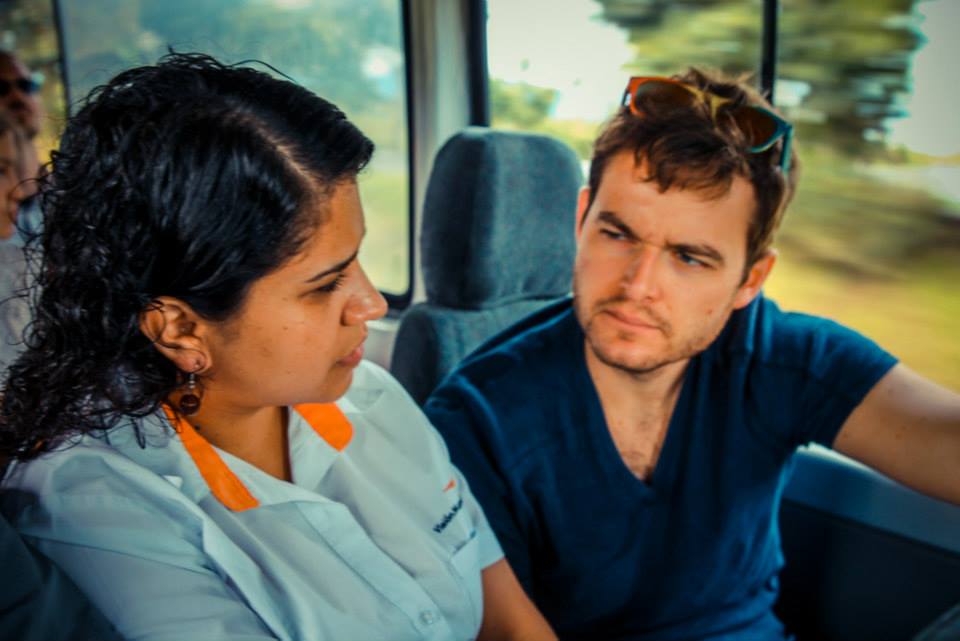
Oh, and the interview took place in a van on the back roads of Guatemala.
As you might imagine, with a face that frightening, it was next to impossible to get my interviewee to be relaxed and comfortable. Especially when I started the interview with the statement, “Sup. I’m Caleb. I’m a funeral director.”
Alma – the lovely lady I interviewed through a translator – is World Vision’s Guatemalan National Sponsorship Coordinator. Her and her team keep track of the 60,000 sponsored children in Guatemala.
She was a sponsored child from the age of five through twelve (she told me she still has the photos of her sponsors in her office desk) and credits World Vision for sponsoring her early schooling; schooling that eventually culminated in a bachelor’s degree in education.
Alma’s very proud of the fact that her children are not sponsored children. She’s proud because her life embodies the story that World Vision is attempting to reproduce; a structure of support that eventually produces self-sufficiency, where World Vision helps people stand on their own. She embodies the best of the World Vision sponsorship program, so who better to lead it?
After making a number of awkward faces while prodding about her life, I made the conversation even more uneasy when I opened up my series of questions about death.
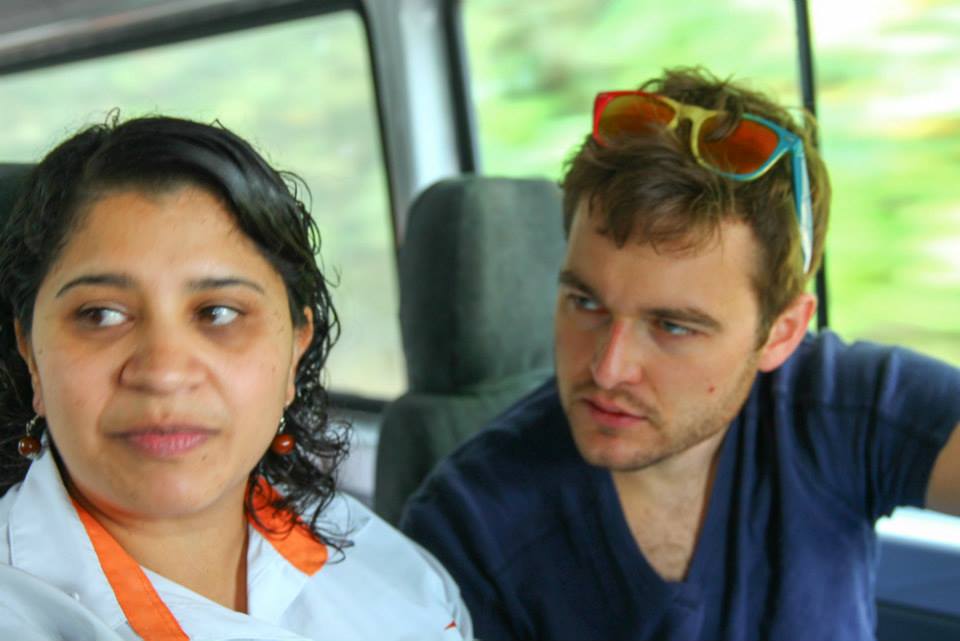
My weird, scary murderer face.
We talked about funeral practices in Guatemala and thankfully Alma understood enough about American culture to provide some contrasts by explaining that there’s no embalming and there’s rarely a funeral director involved in rural Guatemala. Most funerals are at home and for many there’s no casket involved.
Alma told me that the body is carried to a local graveyard and for nine days after burial the family is in mourning, donning black clothes.
I then asked her, “What about children?” It’s here she begins to show some emotion. The conversation moved past information exchange as we reached the heart of her job.
I know some poverty stricken cultures will forgo naming children until they reach a couple months of age. Where infant mortality rates are high (like Guatemala), an unnamed child means less attachment, less love and less grief. With that understanding I didn’t want to assume Guatemala had infant funerals, so I asked, “Are there funeral customs for children?”
“Yes, there are.”
As the conversation trekked onward, I could tell that I was getting close to the need that inspired her passion.
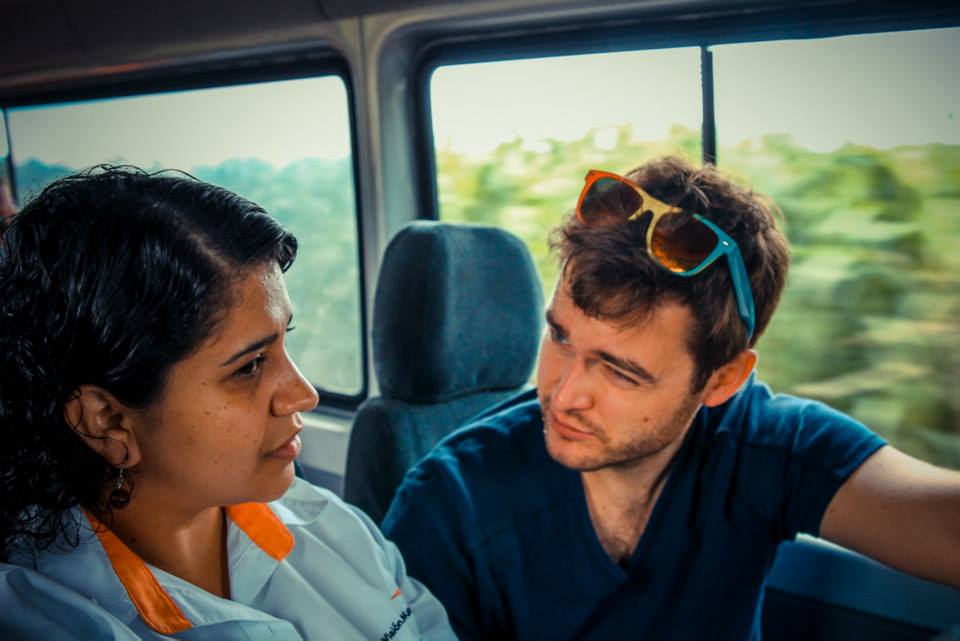
My “Did you just fart?” face.
“And what,” I asked with my ugly face, “is the leading cause of death for Guatemalan children?”
“Malnutrition and preventable sickness” came out of her mouth as though she spoke the name of an enemy. An enemy that was ever present in her mind. An enemy that was as close to her as a lover. An enemy that went to bed with her, that walked with her to work and that motivated her 10 to 12 hour work days. Anger, even hatred, contorted her face as she described how dysentery, “common” infections and even a simple cold will blow out the promise of a new life. How a lack of food will starve a child in the rural areas of Guatemala where work and a nutritious diet are scarce.
“These deaths don’t make me cry” she paused, “they make me angry. They are so easily preventable, so easily solved.” As we talk some more I begin to see a warrior in Alma. A woman warrior. No armor, no swords and shields, but a driven fighter set on saving children from preventable death.
I know how nonprofits work. There’s an enemy that the nonprofit stands against and that enemy is fought with the doubled edged sword of resources and volunteers. When there isn’t enough resources and volunteers, there’s casualties.
In this war – the war that Alma is fighting — the casualties are children.
“Do you feel like you have failed when a child dies?” A resounding, “No.” She says, “Because what we’re doing is a partnership. We are teaching parents to care for their children. I can only do as much as my resources allow me.”
And partnership is the key. You might not be able to volunteer, but you can provide the resources for those who do.
The picture is gut wrenching, dark and sad.
The reality is this: people in poverty need the help of you and me.
It many cases, you can’t money solve a problem. You can’t throw money at the problem and fix it. But in this case, we’re not throwing money at a problem, we’re giving it to people, to a warrior woman like Alma and I believe she knows what to do with it … she can at least save some. Help her.

Seven Reasons You Shouldn’t Support World Vision
The other week I asked this snarky question to my Confessions of a Funeral Director Facebook community:
Over the past two weeks I’ve been attempting to encourage people to join me in sponsoring a child in Guatemala through World Vision.
Within those two weeks over two million people have visited my Facebook page. Out of those two million, two people (that I’m aware of) sponsored a child through World Vision.
I’m both excited and disheartened that my efforts have produced two sponsorships (yeah) from two individuals out of two million (ugh). Honestly, I’m kind of dumbfounded.
So, here’s a question for you: If you donate to charity, what are your motivating factors for doing so?
And, why do you think it’s so difficult to motivate people to give money to something wonderful (like sponsoring an impoverished child in Guatemala) when we will easily give money to something less wonderful (a new shirt that we don’t need, etc., etc.)?
So here are the top seven answers that you posted. And I will respond to each accordingly.
One. It’s better to sponsor an elephant.

I hope you’re not being sarcastic because if I could sponsor a baby elephant, I would too. So you win.
Two. I want to give locally … to ‘Merica.

Okay? You’re selfish?
See, I don’t think we will fix everything here in the US. Like ever. But having worked with vulnerable at-risk youth here in America for two years I can say that there is more opportunity in the US for “poor kids” than there is for “poor kids” in Guatemala, or any other third-world countries.
In the US there’s programs that provide food for the hungry (like food stamps).
There’s *FREE* public education that goes to the 12th grade.
And after high school there’s wonderful aid for low income students to attend college.
There isn’t (systemic) child labor.
There’s a reason why people (especially poor people) from other countries want to come to America.
It’s easy for our perspectives to be limited by our locality. To develop a sense of tribalism and nationalism is only natural. But to see past the limits of sight and find empathy for those outside our borders is – in a way – supernatural. To have a vision beyond self, beyond family and beyond country, to have a vision for the world starts with a recognition that we are citizens of a larger kingdom. And this recognition is why I support World Vision. Not only is World Vision able to empathize with “the other”, but they focus on holistically helping the weakest, the most helpless . . .the children. They are doing what I imagine Jesus would be doing if he was walking the world today which is why I’m so excited to join their efforts in Guatemala!
Three. World Vision is a Christian organization.

Please, don’t misunderstand me … I don’t want you to feel like “World Vision” has the corner on charity. In fact, World Vision itself recognizes this and partners with outside organizations. I also REALLY hope that you have a cause that you’re SUPER passionate about. And, I do REALLY want you to just give, to learn to give and to make giving a part of your life. And I do believe World Vision is a wonderful place to practice giving.
Secondly, World Vision isn’t evangelical in the sense that they evangelize. They are a Christian group attempting to practice the words of Jesus.
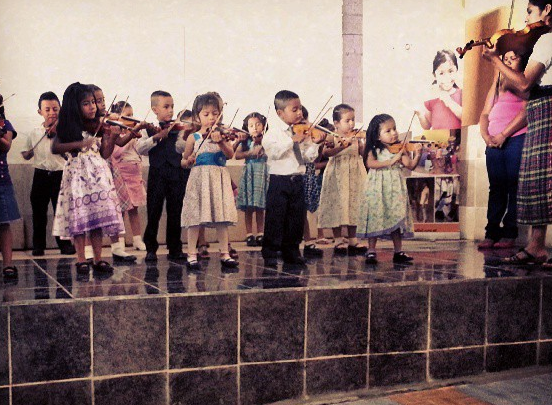
This attempt involves more than words and food, it involves education, health care, economic development, spiritual care, agriculture and clean water. All recognition factors that World Vision does in Guatemala and abroad.
For example, here’s a photo of the Guatemalan World Vision violin school:
But, with that said, I support you donating to secular organizations and hope that you can see that Christians are interested in much more than preaching.
Four. They’re coming to America anyways.

I’m in Guatemala now and there’s a lot of kids here. Sooooooo ….
Five. I’ve got something serious I’m working through.

I wish someone would sponsor your child too! And I say that with tears in my eyes. Give all that you have to your wonderful child.
Six. World Vision is irresponsible with their money.

Yes. When giving ALWAYS give wisely! It is YOUR money. And I know that you are giving to other organizations because you seem like that type of person. Although I do believe World Vision is responsible.
Here’s a response that doesn’t come from my computer keys …
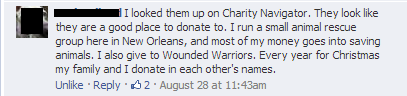
World Vision gives about 80 cents per dollar to the work. The other 20 cents involves advertising, workers and overhead. And I’m okay with that.
Seven. Because consumerism.

So, yes … if you need that new T-Shirt or iPhone … it’s your money … and if you’d rather give your money to a toy … that’s okay. But like the post above states, we’ve all been touched by consumerism and I’m really trying to shake it off. And one way I’m losing that consumerism is by supporting a charity like World Vision.
*****
I’m sure there’s other reasons that people feel they shouldn’t support an international charity like World Vision, but I feel like the above seven are the general ones. Bottom line: I believe World Vision is worth considering. I’m here, on the ground, and it IS working.
Saving the Laughter of Children
After nine years of trying to bring a new life into our family, we wanted a child so much that we adopted. And Jeremiah is simply the greatest gift that we have EVER been given. I’ve always understood that children are precious, but waiting nine years for Jeremiah only amplified that sentiment.
Today in the Guatemalan World Vision base I met Federico. He’s slightly older than Jeremiah, which is why I sponsored him. That age connection with Jeremiah coupled with the intense love I have for my son and the perspective that nine years of infertility have given me was a concoction for emotional wreckage. I knew that meeting a child Jeremiah’s age who is disadvantaged and impoverished would move me to tears. I knew that today would be intense … that my love for Jeremiah would somehow and in someway pour out to Federico.
I came to this three hour meeting prepared for the emotional roller coaster. I had plenty of deodorant (cause I tend to get body odor when I’m emotional), breath mints (cause I’ve been drinking and drinking all this wonderful Guatemalan coffee) AND I brought a soccer ball, tennis ball sized bouncy ball and an authentic Mexican cowboy hat as gifts … just because I’m cool like that.
All ten of us “World Vision Bloggers” arrived at the World Vision base to find it decorated with balloons and our sponsored kids waiting in anticipation to meet their “godparents” (all the Guatemalan children call their sponsors “godparents”). To my surprise, Federico’s brother Christian also came with him, so I divided up my gifts. I gave Christian the sombrero and the bouncy ball, but I gave the best present – the soccer ball – to Federico.
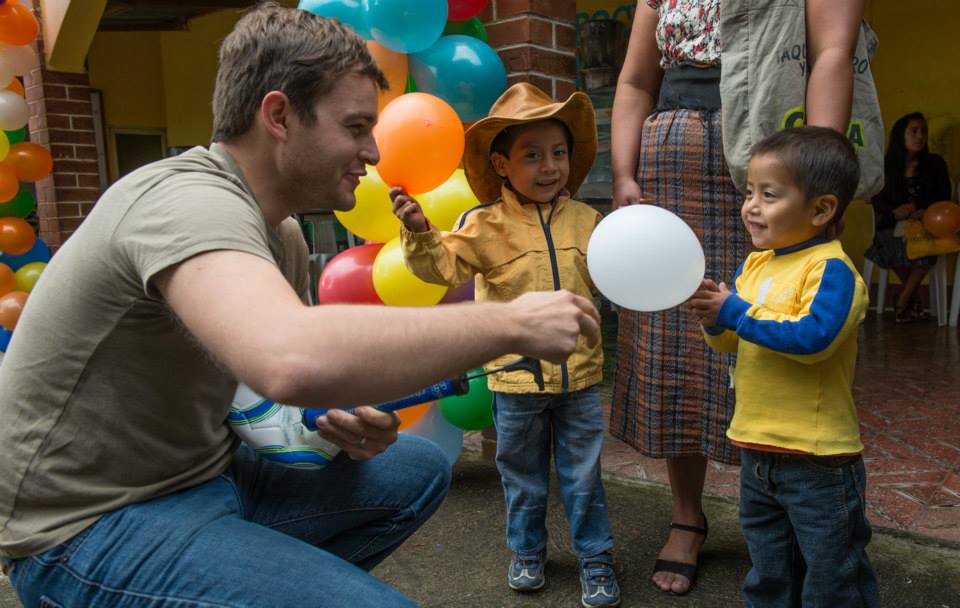
Me giving my gifts to Federico and Christian :: Photo credit Laura Reinhardt

Federico :: Photo Credit Laura Reinhardt
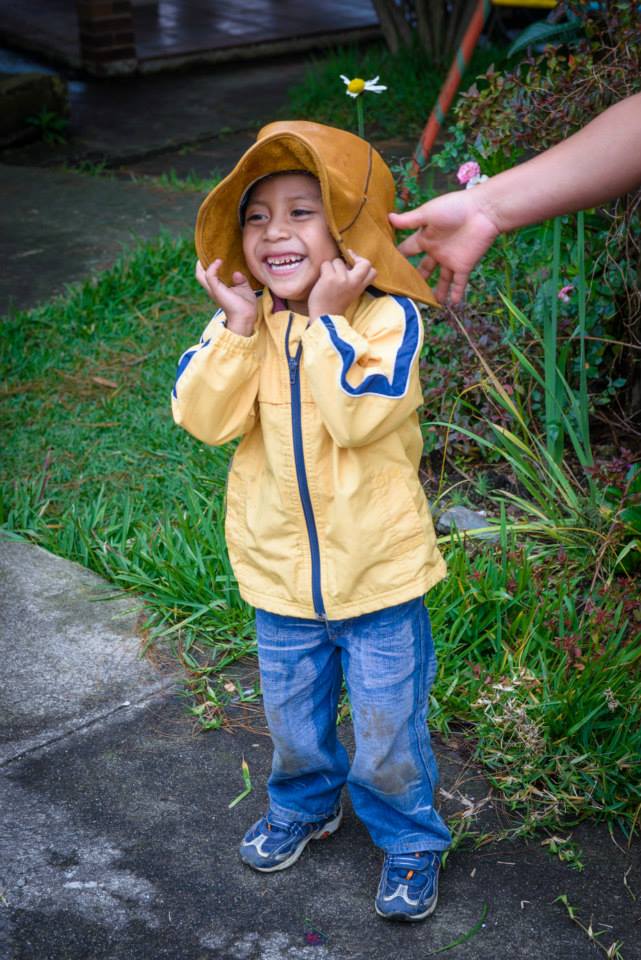
Christian :: Photo Credit Laura Reinhardt
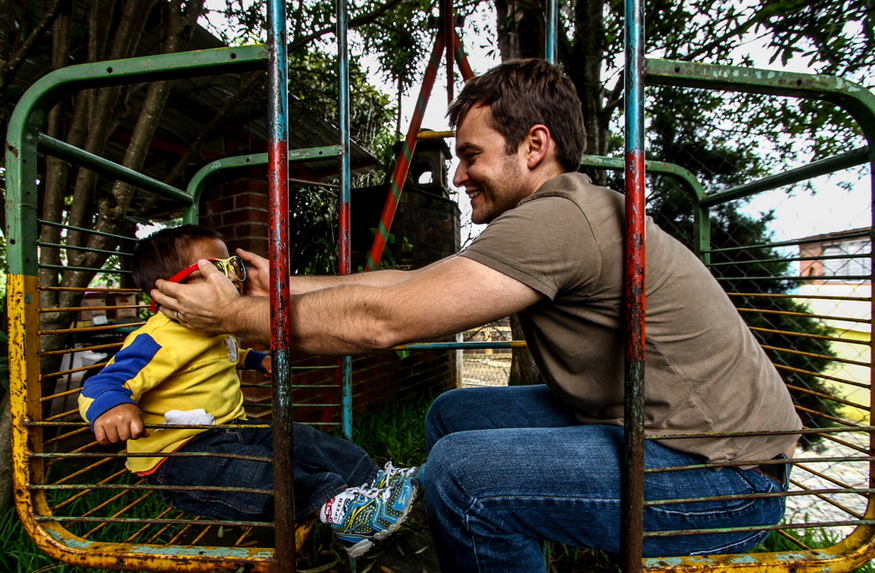
Putting my sunglasses on Federico :: Photo Credit Matthew Paul Turner
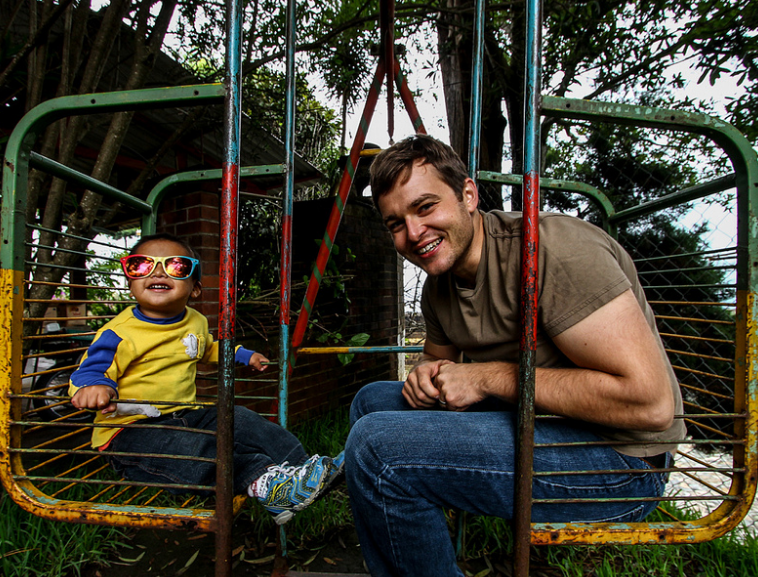
Photo Credit Matthew Paul Turner
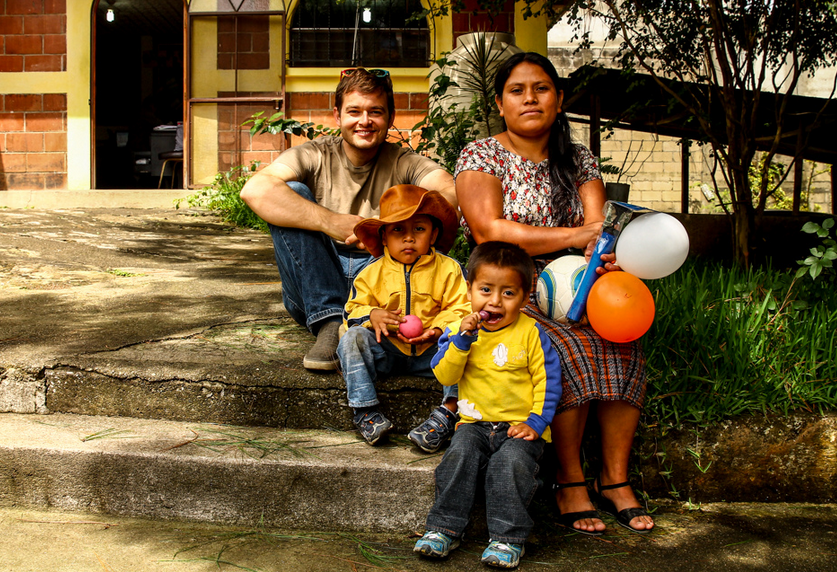
From left to right: Me, Christian, Federico and their mother :: Photo Credit Matthew Paul Turner
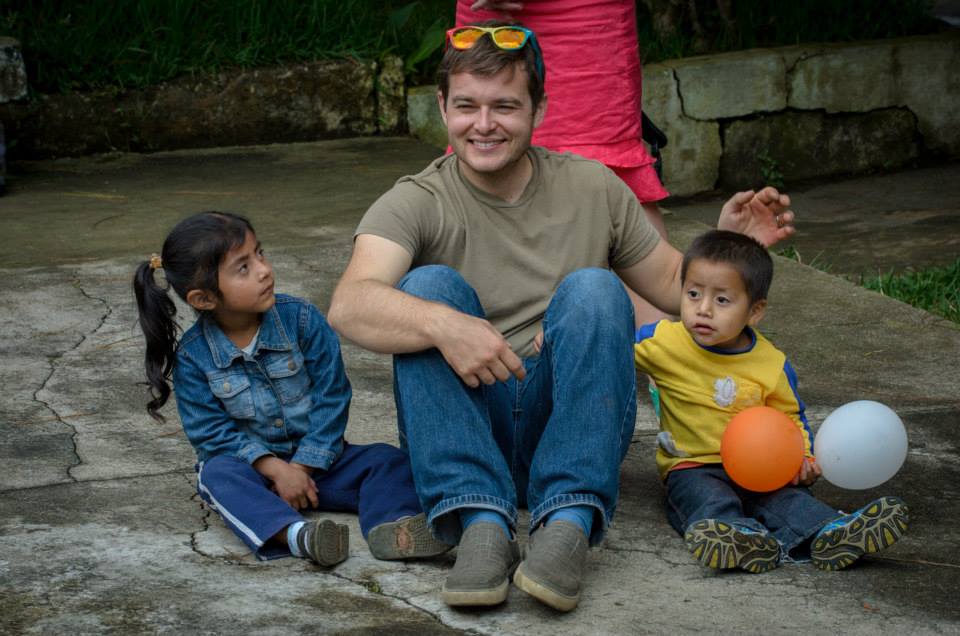
Photo Credit Laura Reinhardt
At first I followed Federico around to the metal swing set, then we kicked his soccer ball back and forth and — to the delight of everyone — I let Federico and Christian tackle me. Just like Jeremiah, they jumped on top of me and I lifted them up, making them fly as they giggled and laughed with such a genuine laughter that it seemed they were having the time of their lives. These children are just like Jeremiah. Just like your children their belly laughter has the endearing ability to make you believe that the world is full of goodness. And that you — THAT YOU — at this very moment are the source of all the goodness. For a second, for a moment, their laughter helps us believe again.
It helps us believe that there’s more than darkness and pain. That love and goodness and faith exist. That there is life before death and that it’s okay to smile and love and forgive. It seems that all those things that have been buried by the dirt of pain, bitterness, selfishness and hate are all uncovered at the very sound of a child’s laughter … as though their laughter is the very language of God.
As I write this and remember Federico and Christian’s laughter, I do believe. I do. Through the holistic approach of World Vision and my sponsorship, both Federico and Christian’s laughter will not end with our game of airplane. They will have the opportunity that I will give to my son. They will have the opportunity to believe and dream for stability and health. They can break the cycle of generational poverty. They can raise a family, play airplane with their children and let the sounds of laughter wash away the terrors of the world.
After three hours, I was no longer following Federico around. He was following me. I, his friend … his godparent. And I will do my part to keep him laughing. To fly. To believe. To dream. Together.
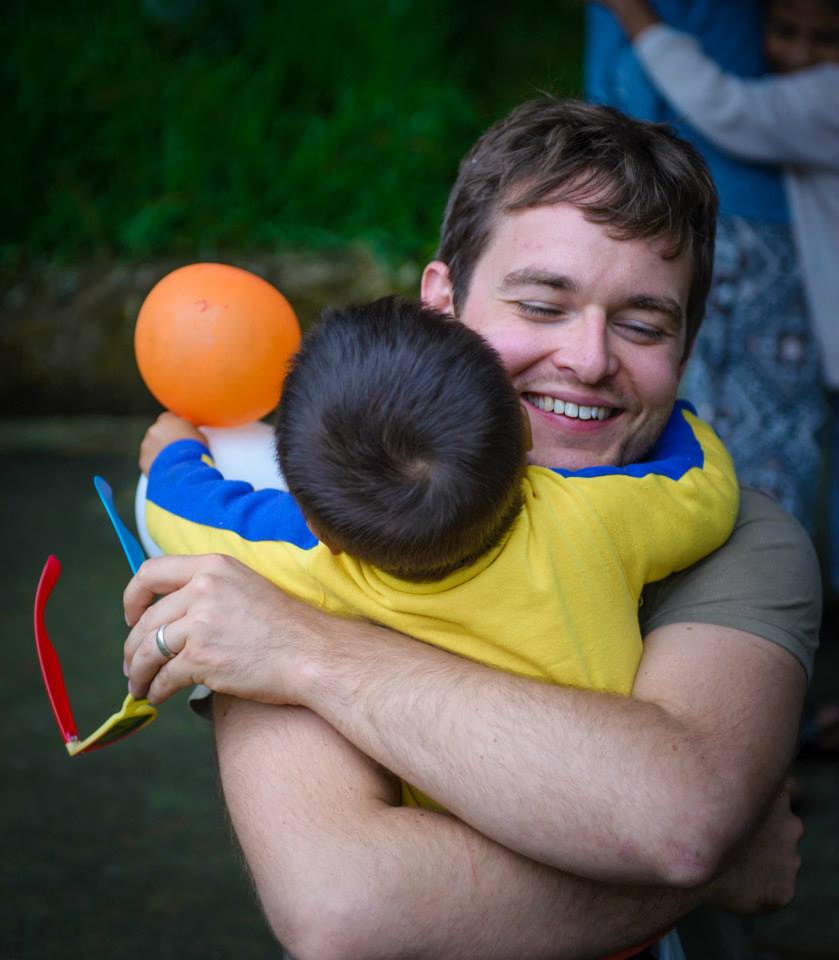
Photo Credit Laura Reinhardt
PLEASE join me in saving the laughter of these children. Join me by sponsoring a child through World Vision. Please, click here.
Poverty Pornography
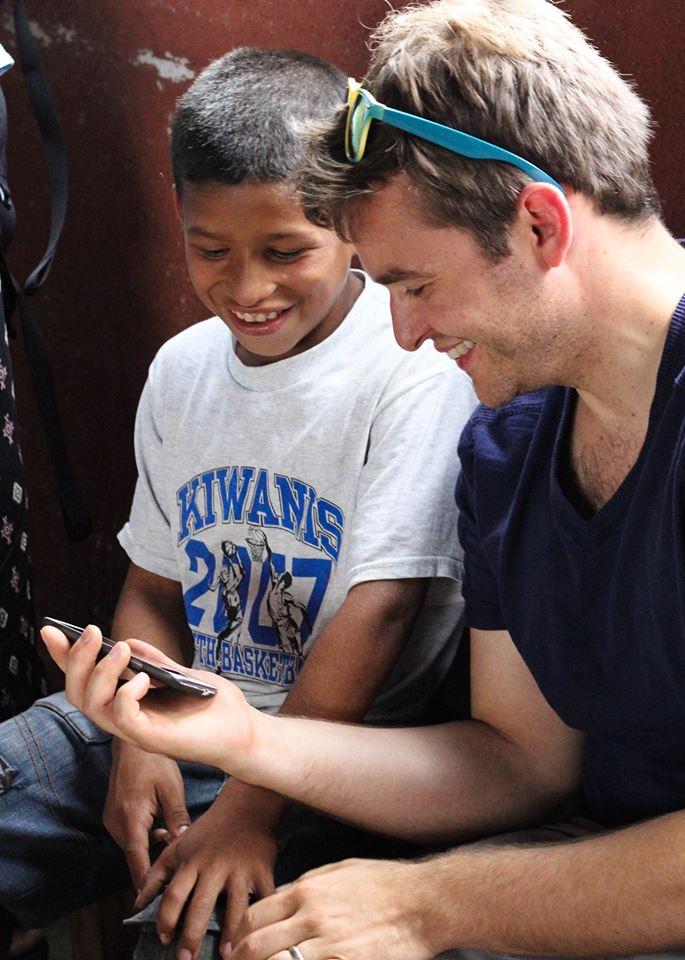
Me playing Angry Birds with a young Guatemalan. Photo credit Jessica Chenevey Shyba.
Today I saw children destined for a greatness that will go unrealized. Undernourished until the age of three or four, their bodies will remain in an underdeveloped state where body, mind and spirit will be delayed from now until death. In this area of Guatemala, 9 out of 10 children suffer from this debilitating chronic malnutrition.
Ultimately, they suffer from poverty. And when I say “poverty” your mind may conjure up photos and videos that act – in some way – like poverty pornography. These imagines depict a situation with all the flesh and emotion without the person. You’ve seen plenty of poverty porn on commercials that attempt to guilt you into sponsoring a poor kid with graphic images of “poverty.” Or that god-awful traumatizing Sarah McLachlan ASPCA commercial that guilts you into adopt 100 homeless dogs and cats. I want to move beyond the starving puppies and move towards the humanity in poverty.
Poverty isn’t just basketball bellied African children with flies hovering around their desperate imploring eyes.
And those who are impoverished aren’t so because they are evil, or because God has cursed them or because they have a bad case of the stupid.
Poverty isn’t simply a lack of financial means. Nor is it caused by a LACK of hard work, responsibility, character or godliness.
Poverty isn’t always a choice brought on by people who would rather sit on their couches than work an honest day’s labor.
And poverty IS NOT something you can climb out of all on your own. You can’t just get out of it with an “I can do this all by myself” good ‘ol ‘Merican attitude.
Those in poverty are not deficient human beings who are on a lower rung in the echelon of human evolution … one step above the really smart sign language monkeys. They are people just like you and like me. Well, except they haven’t watched the latest Breaking Bad episode … and they probably know nothing about the iPhone 5s and 5c release.
“Those people” are the people who go hungry because they’ve given all their portion to their malnourished children.
People who work harder than you and I and yet still don’t have enough funds to provide the basic nourishment needed for the physical and mental development of their children.
Like the family I met today. The husband walks from farm to farm looking for stable work, waking at 5 AM and coming home at dark, while his wife tends the children and their garden of corn and beans at home.
These are people who believe in Fate because they have no control over the outcome of their sick child. With no access to healthcare, it’s “que sera sera” (now that song will be stuck in your head all day … mwahahaha). There is no fix for sickness, no doctor for healing and no saving grace of medicine. There is what will be, be it life or death.
And this impoverishment produces a cycle of generation poverty.
When a child has chronic malnourishment and the permanent physical and mental delay that comes with it, there isn’t any opportunity here in Guatemala for him or her to be anything more than a low paid worker, or – worse yet – a gang member.
This is the reality. And it’s not nice. Of course poverty exists in America, but this isn’t America’s poverty. There’s no brush that I can use to paint rainbows and unicorns on this canvas. The picture is gut wrenching, dark and sad.
This isn’t the life they want, nor is it a life they can choose to escape. The reality is this: people in poverty need the help of you and me. It’s just how it is. Let them realize the greatness God intends. Join me with World Vision.