Guest Posts
Facing Death with a Smile
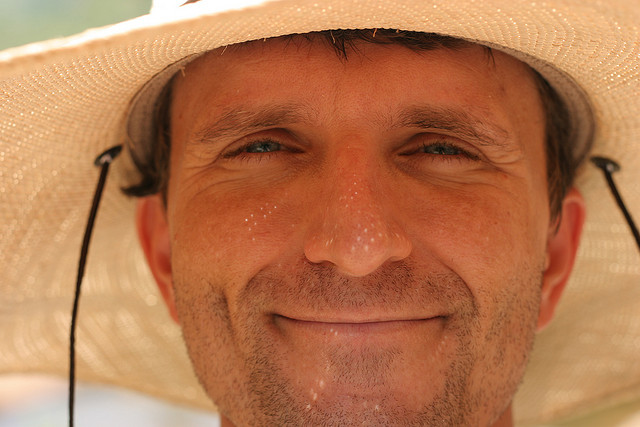
Photo from Flickr user SuperFantastic
Today’s guest post is from Christopher White. Christopher resides in Australia with his pug “Freddy”.
I am 64 years old, have led a healthy life, don’t smoke, enjoy a drink occasionally and I tend to avoid stress. I have never married, no kids, have a great family, and life is pretty well perfect. I have many wonderful friends and no enemies.
I began to feel unwell in about June this year – just vague feelings of not being at my best. My health became progressively worse, despite monthly attendances at my local doctor, who had been taking regular blood tests. One month ago I went to see him, I lay on his couch and he tapped two fingers into my abdomen area. I couldn’t believe the pain – he said “There’s something wrong here, you better get to the hospital straight away.” I had a mate deliver me to the local town hospital. He said on the way “They are going to ask you what your allergies are. Tell them you are allergic to big women with tattoos.”
Admitted through the emergency department, rushed into the scanning and X-ray departments, transferred by ambulance to another hospital about 50kms north, where I was taken in for an emergency operation.
When I came around, several hours later, the doctor told me they had removed about 40cm of cancerous growth in the intestines – he called it a bowel resectment. I spent 16 days in the intensive care recovery until, very well tended by both medical staff and the nursing team. Some of the other patients were a different story – I am unused to spending sleeping time with others, with their snoring, loud mobile phone conversations at all times of the day and night and people just being plain rude to each other. “Hey nurse – where’s my bloody pain killer – should have been here half an hour ago?”
When a nurse asked me how I had slept, I said that the snoring from across the passage was like “listening to a rainforest being destroyed.” I suggested that, armed with a baseball bat, some of us in the ICU would have got a lot more sleep, and that business may have been a bit brisker downstairs in the emergency admissions department.” She laughed, a bit, and said “You will recover quickly – grumpy old men always do better.” I am also pleased I did not pass on anything about being allergic to large women with tattoos, as this was an accurate description of most of those taking my blood and doing other tests.
The medical team have advised me to have lots more tests later in the year, to make sure all the cancer has been removed. One man even said “You might get better, or you might die – it is hard to say at this stage.”
I had plenty of time to think about things, stuck there in my little calico cubicle. I managed to blot out the neighbouring surroundings, and just had a really good think about things in general. I have had a very easy life – never been involved in a war, feuds, arguments. I have never had to work too hard, things have come easily to me. Always enjoyed good health – hardly ever had an unhealthy day in my life. I thoroughly enjoy my job, which involves running a small B&B here in a beautiful part of the world.
In a way, my life has been like attending a pleasant party, when one of the ushers taps me on the shoulder and says “OK mate, your time is up and you have to leave.” My first reaction is to say “Well, thanks for having me, which is the easiest way out?” I have never felt anger, betrayal, denial or “Why me? I don’t deserve this.” Instead, I have a serene feeling of relief and acceptance.
I see clearly the advantages of early checkout. OK, 64 is a bit early, but when is really the right time? There will be no Alzheimers Disease, no lonely old age in some grey nursing home, being fed on paste, and having someone else attend to my bathroom needs. No eccentric old man living in a boarded up house in unhealthy conditions, smelling of cat urine. I have few regrets – one of the main ones is leaving my two year old Pug dog Freddy, even though I know he is being left in the best of care.
If the cancer has spread, or returned, I reckon I have about nine months to prepare for the end. I am very fortunate to have a great friend to look after me, cooking, cleaning, company, transport etc. I am very grateful that I do not have a thing to worry about. This is more than long enough to get my affairs in order – most of that has already been done. I am glad there are no awkward reconciliations to endure. I await my own change of cosmic address with a good deal of interest.
What funeral photography is about: 5 steps
Today’s guest post is written by Australian funeral photographer John Slaytor:
When I tell people I’m a funeral photographer they can be slightly taken aback. They remove “funeral” from the occupation and replace it with “wedding”.
They think, “How can you be a photographer at a funeral? How can you ask people to smile?”
Well, that’s not quite the point. And here are 5 (there are heaps more) points I’d like to share about being a funeral photographer. It might not be what you first imagine!
ONE. A funeral photographer isn’t a wedding photographer!
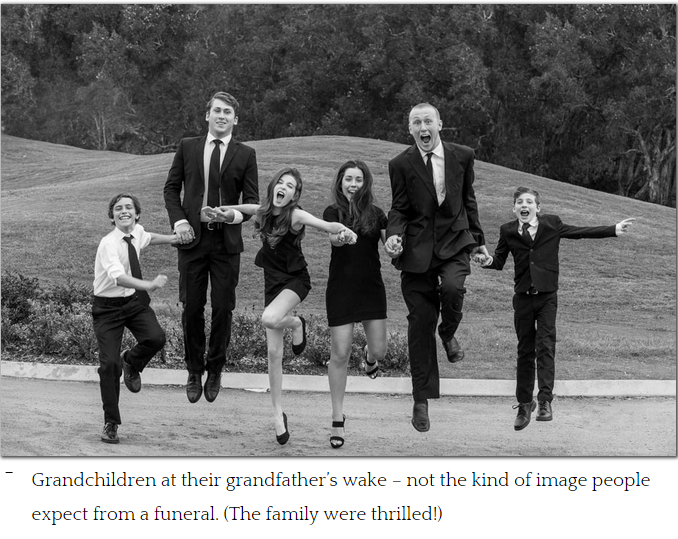
When a wedding photographer turns up at a wedding everyone knows what to expect and how to behave. When I turn up at funerals people don’t know what to expect. They’re not in a familiar situation and didn’t expect a photographer to be present. There’s no protocol with a funeral photographer so once they’ve seen you they tend to ignore you. You thus become invisible and it’s at that point that you can take really good photos.
TWO: Discretion is key to funeral photography
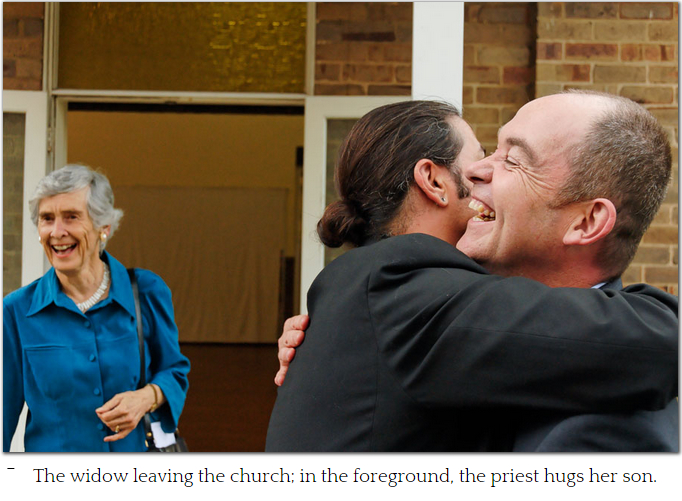
As you move around discretely, you can capture love, tenderness and genuine emotion. No one is performing for the camera. You also do have images of people smiling and laughing, it’s not all blubbering and red eyes from weeping, as people so frequently imagine.
THREE: As a funeral photographer you get to capture tenderness
At funerals people are at their most human and it’s this that I love capturing.
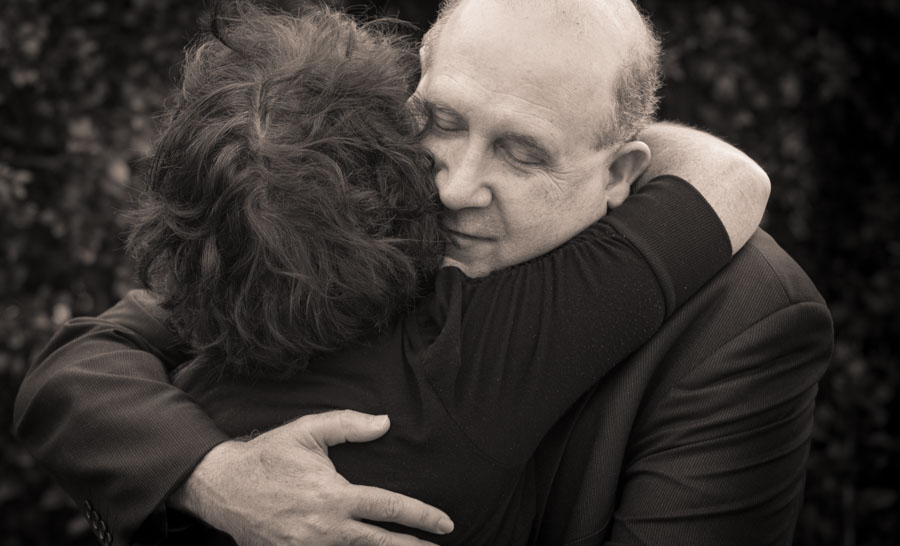
I’m interested in people’s humanity. Capturing tenderness. It’s the emotion that people give to each other that is the most moving.
FOUR: As a funeral photographer you’re enabling people to grieve
You perform a service. You’re recording a gathering of people who’ve loved the deceased and it’s that love that you’re capturing. You’re giving them something that they can remember and look at and see a family/friends united. So you are preserving the memory of a person.
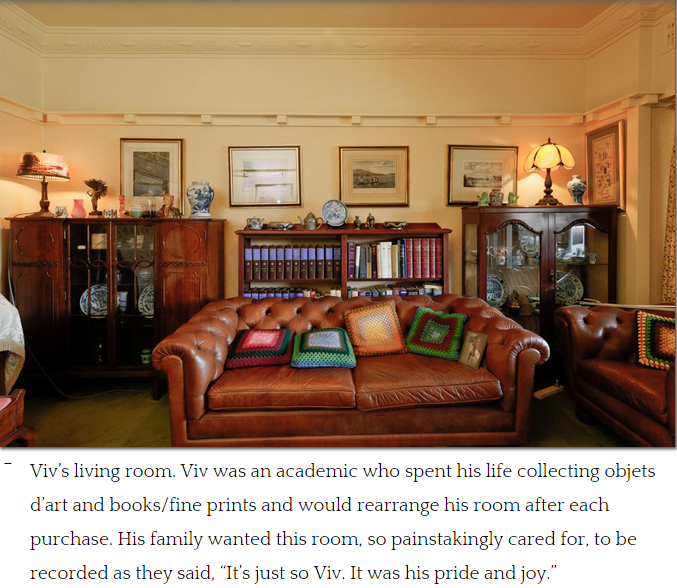
FIVE: As a funeral photographer you’re giving something tangible to preserve memories
In the west we’ve dispensed with death. The reminders of death (gravestones) are diminishing. Photos are one of the few ways left of preserving that memory by something tangible.
*****
ABOUT THE AUTHOR: John Slaytor has photographed funerals since 2007.
A professional photographer, John Slaytor’s photography has been purchased by Australia’s major institutions including the National Portrait Gallery, the National Library of Australia and the State Library of NSW.
An acclaimed photographer, John Slaytor has been in Australia’s most prestigious photography competitions including the National Photographic Portrait Prize, the Olive Cotton Prize and the Moran Photographic Prize.
You can visit John’s website by clicking the link: thefuneralphotographer.com.au
FIVE MYTHS ABOUT FUNERAL DIRECTORS
Today’s guest post is written by Pastor Dieter Reda:
Over the last 34 years of pastoral ministry I have conducted hundreds of funerals. That means I have worked with scores of funeral professionals. My ride to the cemetery is usually in the lead car, which normally is driven by the director who is in charge of a particular funeral. Sometimes it is a short ride, but there have been some longer trips also to distant cemeteries or to burials in a rural cemetery way out in the boonies. The conversations have ranged from the polite professional, to swapping stories, to the occasional theological conversation. In any case, when you spend time in close confinement with someone on a repeated basis, you get to know something about their personality and what makes them tick. And then there were two years of hiatus from ministry; time that I needed to heal some personal wounds. In that time I worked first at cemetery sales, and then spent a year in a corporate funeral home. That presented even more opportunity to spend time with funeral directors up close.
The majority of the men and women I worked with are capable and compassionate professionals, who believe strongly in what they do, and sincerely try to help the families they serve. For some however it is just a job, and a very small minority should probably be in a different line of work. But that is true of all professions, including the ministry. Some of the people I worked with, I would trust to look after my family, and in fact one of them did. A very few I would not trust with the burial of my dog. Several have remained my friends to this day.
Many directors struggle with the myths and stereotypical generalizations about their work and their role. . Here are some of the more common myths and my response based on being up close and personal with a number of these professionals.
- Funeral Directors are only in the business for the money. That is partially true for almost anyone who is gainfully employed. Everyone would like fair compensation and many if not most of us think that should be as much as possible. Some of the funeral directors that I was close to revealed their income level to me and frankly I was appalled how little they are paid. I would suggest that it takes a special kind of person with a deep commitment to what they do, to work the long hours that funeral professionals do, which often includes holy days and public holidays on which the general work force is paid not to work. Like doctors, nurses, police, fire fighters, ministers and others, a funeral director often has to work when everybody else is having fun. Some of the others are paid double time for those efforts, but not the funeral director. When a death happens on Christmas Day, we expect someone to be available when we call the funeral home. If you want to be in something “just for the money”, the funeral business is not the place to be, unless you happen to own a funeral home. Nowadays many of them are owned by huge corporations, and yes they are very profitable.
- Funeral Directors are opportunists who prey on other peoples’ vulnerability. The assumption is that funeral homes take advantage of the fact that you are emotionally distraught as you come to make final arrangements and that therefore they will manipulate you into spending as much money as possible. While there are unscrupulous people in every profession, the truth that I have observed is that most funeral directors prefer that the principal mourner not be alone when it comes to financial decisions such as what casket to purchase. Most encourage that other members of the family, or perhaps even close friends take part, in order to avoid making emotional and unwise decisions. I have known more than one director who has persuaded someone to consider a more affordable option. That is why they also advocate making pre-arrangements at a time when one can carefully consider what is affordable.
- Funeral Directors are aggressive sales people. My experience has shown me that actually very few of them are skilled sales people. Most of them are “order takers” who try and find what it is that the customer wants, and then make that happen. I have seen the “used car salesman” type of funeral director only in the movies. In real life, a mortician couldn’t stay in business if he or she had a reputation about such antics.
- Funeral Directors are insensitive Fakes. I actually met one, but only one such professional. It seems that no matter where you saw him, he had weepy eyes that actually could produce tears on demand, and he always spoke in that soft stained glass whisper. We don’t expect funeral professionals to pretend to be mourners. I have always appreciated the ones that are respectful in their demeanor, even when the funeral involves rituals that are contrary to a director’s beliefs. I don’t expect a director to sing the hymns, recite the creed or the prayers, but I would appreciate it if he did not whisper and joke with a colleague during such moments, and yes I have seen that too! When a family is a gravesite, the worst sight for them is to see the funeral staff standing behind the cars laughing and joking during the service, only to put on the soft whisper when they hold open the door to the limousine. That is fake, but according to my observation that is the exception, rather than the rule. Most of those that I have observed are respectfully professional, and others are genuinely compassionate.
- Funeral Directors are Experts about Everything on Death and Dying. To be honest, some of the younger newly licenced directors do come across that way. I had to remind one young colleague that he often served people who were much more educated than he, and know more about psychology, grief, to name just a few things. While more and more funeral directors now have university degrees, here in Ontario the educational requirements are minimal. A High School diploma will get you admitted into the “Funeral Services” program at one of the colleges in Toronto. This involves 1 year (2 semesters) of classes and embalming labs, followed by a 1 year apprenticeship in a licenced funeral home, after which time the provincial licence exam is written. The licence entitles you to embalm, and to sell and make at-need funeral arrangements. It does not however make you an authority on grief counselling, financial and estate planning, medical issues, and many other things that some funeral directors like to pontificate about. Neither does it make you a theologian, although I was surprised by how many former ministers ended up in the death care industry.
I have come to the conclusion that it takes a very special person to pursue this calling. Someone with a unique set of skills to deal with both the living and the dead. My advice: get to know one, preferably before you need to.
*****
Dieter Reda has been an ordained Minister for the past 34 years and served various churches in central and western Canada. Since 2003 he is senior pastor at Mission Baptist Church in Hamilton, Ontario (Canada). His blog of pastoral musings on various issues is at www.dieterreda.com and you can follow him on Twitter @Dieterreda.
A Sailor’s Dying Wish
Today’s guest post is written by Jennie Haskamp:
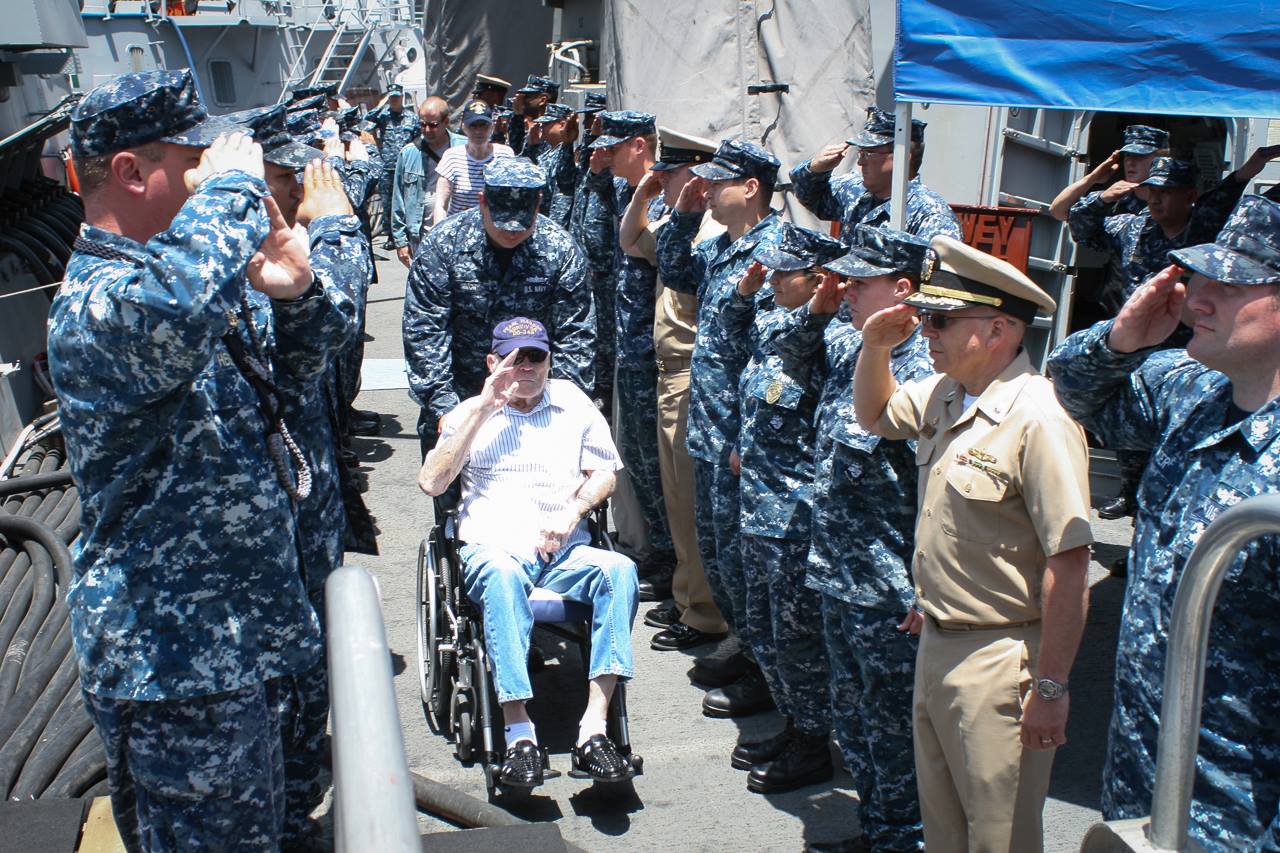
After signing my Pop, EM2 Bud Cloud (circa Pearl Harbor) up for hospice care, the consolation prize I’d given him (for agreeing it was OK to die) was a trip to “visit the Navy in San Diego.”
I emailed my friend and former Marine sergeant, Mrs. Mandy McCammon, who’s currently serving as a Navy Public Affairs Officer, at midnight on 28 May. I asked Mandy if she had enough pull on any of the bases in San Diego to get me access for the day so I could give Bud, who served on USS Dewey (DD-349), a windshield tour.
The next day she sent me an email from the current USS Dewey (DDG 105)’s XO, CDR Mikael Rockstad, inviting us down to the ship two days later.
We linked up with Mandy outside Naval Base San Diego and carpooled to the pier where we were greeted by CMDCM Joe Grgetich and a squad-sized group of Sailors. Bud started to cry before the doors of the van opened. He’d been oohing and pointing at the cyclic rate as we approached the pier, but when we slowed down and Mandy said, “They’re all here for you, Bud,” he was overwhelmed.
After we were all out of the van directly in front of the Dewey, shaking hands and exchanging pleasantries, Petty Officer Simon introduced himself and said as the ship’s Sailor of the Year he had the honor of pushing Bud’s wheelchair for the day. Unbeknownst to us, they’d decided to host Budaboard the Dewey, not at the Dewey. And so they carried him aboard. None of us expected him to go aboard the ship. I’d told him we were going down to the base and would have the chance to meet and greet a few of the Sailors from the new Dewey. He was ecstatic. The day before, he asked every few hours if we were “still going down to visit the boys from the Dewey,” and “do they know I was on the Dewey, too?”
Once aboard, we were greeted by the CO, CDR Jake Douglas, the XO and a reinforced platoon-sized group of Sailors. To say it was overwhelming is an understatement. These men and women waited in line to introduce themselves to Bud. They shook his hand, asked for photos with him, and swapped stories. It was simply amazing.
They didn’t just talk to him, they listened.
Bud’s voice was little more than a weak whisper at this point and he’d tell a story and then GMC Eisman or GSCS Whynot would repeat it so all of the Sailors on deck could hear. In the midst of the conversations, Petty Officer Flores broke contact with the group. Bud was telling a story and CMDCM Grgetich was repeating the details when Flores walked back into view holding a huge photo of the original USS Dewey. That moment was priceless. Bud stopped mid-sentence and yelled, “There she is!” They patiently stood there holding the photo while he told them about her armament, described the way it listed after it was hit, and shared other details about the attacks on Pearl Harbor.
Bud finally admitted how tired he was after more than an hour on deck. While they were finishing up goodbyes and taking last minute photographs, GMC Eisman asked if it’d be OK to bring Sailors up to visit Bud in a few months after a Chief’s board. I hadn’t said it yet because I didn’t want it to dampen the spirit of the day, but I quietly explained to GMC Eisman the reason we’d asked for the visit was simple: Bud was dying.
I told him they were welcome to come up any time they wanted, but I suspected Bud had about a month left to live. Almost without hesitation, he asked if the crew could provide the burial honors when the time came. I assured him that’d be an honor we’d welcome.
Leaving the ship was possibly more emotional than boarding.
They piped him ashore. CMDCM Grgetich leaned in and quietly told me how significant that honor was and who it’s usually reserved for as we headed towards the gangplank. Hearing “Electrician’s Mate Second Class William Bud Cloud, Pearl Harbor Survivor, departing” announced over the 1MC was surreal.
Later that night Bud sat in his recliner, hands full of ship’s coins and declared, “I don’t care what you do with my power tools; you better promise you’ll bury me with these.”
He died 13 days later. For 12 of those 13 days he talked about the Dewey, her Sailors and his visit to San Diego. Everyone who came to the house had to hear the story, see the photos, hold the coins, read the plaques.
True to his word, GMC Eisman arranged the details for a full honors burial. The ceremony was simple yet magnificent. And a perfect sendoff for an ornery old guy who never, ever stopped being proud to be a Sailor. After the funeral, the Sailors came back to the house for the reception and spent an hour with the family. This may seem like a small detail, but it’s another example of them going above and beyond the call of duty, and it meant more to the family than I can explain.
There are more photos, and I’m sure I missed a detail, or a name. What I didn’t miss and will never forget, is how unbelievable the men and women of the USS Dewey were. They opened their ship and their hearts and quite literally made a dream come true for a dying Sailor.
They provided the backdrop for “This is the best day of my life, daughter. I never in my whole life dreamed I’d step foot on the Dewey again or shake the hand of a real life Sailor.”
Without question, it’s the best example of Semper Fidelis I’ve ever seen.
*****
Jennie Haskamp is a Marine Corps veteran. Follow Jennie’s personal blog HERE. And to read a follow-up to the post you just read, click HERE.